The full guide
What changes in this game?
A shortened deck changes the cards you can draw, while special 21 payouts change which outcomes are valuable. Both sides belong in the strategy.
Version covered: The shortened-deck Match Play 21 operator rules linked below. Its natural-blackjack payout needs confirmation from the exact game because public reference tables differ.
For comparison, ordinary blackjack uses standard 52-card decks, pays qualifying naturals according to the table, and normally pushes equal ordinary totals. Never assume every other rule stays the same.
| Feature | This reference version | Why it matters |
|---|---|---|
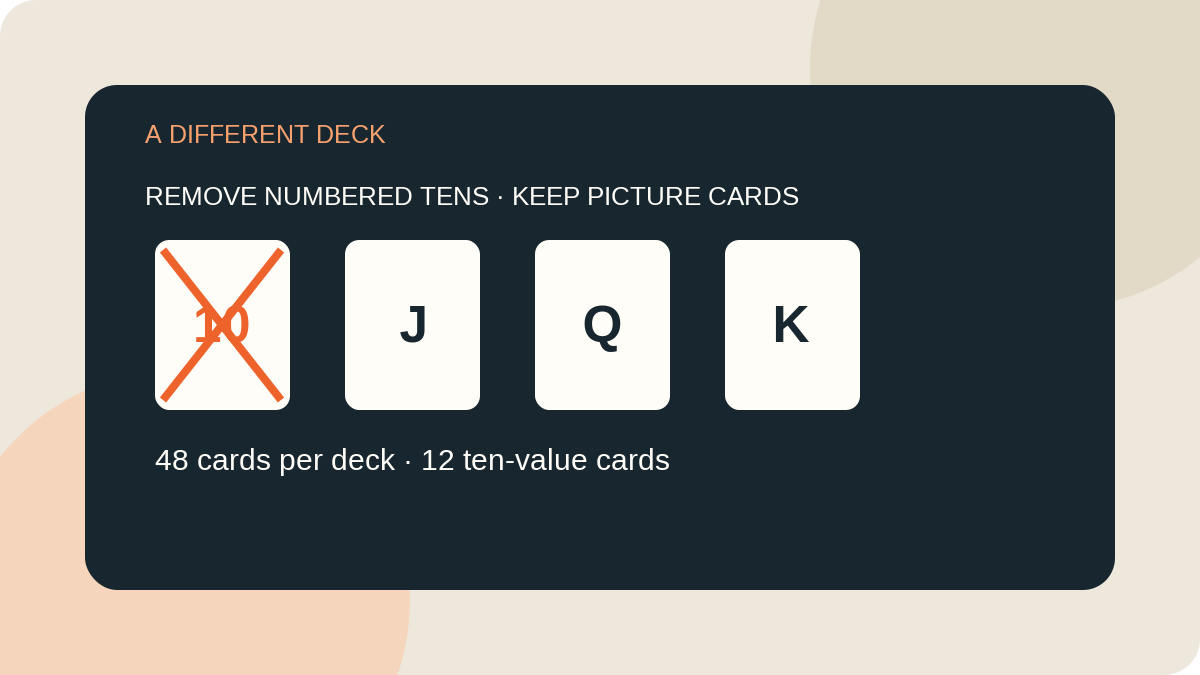
| Deck composition | Remove the four numbered tens from each standard deck; keep J, Q and K. | There are 48 cards, including 12 ten-value picture cards, per deck. |
| Long 21s | The reference awards 3:2 for five-card 21, 2:1 for six-card 21 and 3:1 for seven-or-more-card 21. | The number of cards matters, not merely the total. |
| Bonus eligibility | The listed special awards are excluded on doubled and split hands. | An extra-action decision can change the payout you are pursuing. |
| Natural payout | Public tables do not agree clearly enough to give one universal natural payout here. | Confirm the exact payout and priority against dealer blackjack; do not substitute Spanish 21 rules. |
How the strategy differs
Count the remaining ten-value cards
Removing numbered tens does not remove every card worth ten. Jacks, queens and kings remain. In a fresh shortened deck, 12 of 48 cards are ten-valued: 25%. In a standard fresh deck it is 16 of 52, about 30.77%. These are deck fractions, not probabilities of winning a hand.
Read the whole bonus ladder
The operator reference also lists combination and suit awards involving 6-7-8 and 7-7-7. A special award is part of the main-hand rules, not automatically a promotional casino bonus. Check the exact qualification, whether awards combine, and which actions remove eligibility before treating a displayed multiplier as payable.
Why a total-only chart is insufficient
Two hands can show the same total but have different card counts and paths to a qualifying award. Doubling also changes both the wager and special-payout eligibility. A conventional 52-card chart does not capture that combination of changed probabilities and changed rewards.
Do not fill gaps with a similar game
The operator’s natural rows are unclear, while the RTG directory analysis lists a different natural payout. They may describe different configurations. This guide therefore does not assign a single house edge or a precise complete strategy. Use the exact in-game rules and a reference analysed for that version; similarity to Spanish 21 is not enough.
Before your first hand
- Confirm the deck really removes numbered tens.
- Find the natural payout and player/dealer priority.
- Read card-count, suit and combination qualifications.
- Check which awards disappear after doubling or splitting.
Common questions
Are there no tens left in the deck?
There are no numbered ten cards in this version, but J, Q and K still count as ten.
Can I copy a Spanish 21 chart?
Only if its complete rules, payouts and restrictions match. The family resemblance is not sufficient.
Choose a matching strategy. Our interactive standard chart and practice trainer teach their own stated rules. They do not simulate this variation. Use the version-specific references below for variant decisions.
Compare another game
Rules and strategy references
- Match Play 21 operator rules and bonus ladder ↗
- RTG configuration listing, including its separate natural-payout figure ↗
Public references checked 29 October 2026. The examples use the stated rules; they do not establish current casino availability, a universal house edge or a guarantee of results.
Check your understanding
Three quick questions. Choose an answer to see why it fits. Your answers stay on this page.