The full guide
Keep the count. Make the play.
A guided Hi-Lo practice table. Reveal each card, watch the count change, then choose your move.
Dealer
Your hand
How this practice table works
Each lesson starts partway through a six-deck shoe. Its starting count comes from 156 previously exposed cards; those cards are removed from the simulated shoe. New visible cards update the running count immediately. The dealer’s face-down card stays uncounted until revealed.
Rules: dealer stands on soft 17; double on any first two cards; no surrender. These lessons start with hard, non-pair hands and focus on hit, stand and double decisions. Splitting, insurance, betting systems and other index plays are outside this trainer. Dealer ten-up hands are checked for blackjack before your turn.
Unseen decks include the dealer’s hidden card. The display shows the exact true count to two decimals; the decision index rounds down toward negative infinity (−1.2 becomes −2). Double recommendations become hit when doubling is no longer available. Each new lesson creates a fresh practice snapshot, rather than continuing the previous shoe.
A different result does not make a good decision wrong. Judge the play by the information available when you choose. These are learning scenarios, not predictions of profit. Counting relies on cards staying out of the shoe; it does not carry across independently shuffled rounds or continuous shufflers.
Index reference: Wizard of Odds: Hi-Lo and the Illustrious 18. Practice basic strategy first with our blackjack strategy chart.
Put the lesson into practice
Follow exposed cards, distinguish running and true counts, and practise departures only within the tutorial’s stated rules.
Count cards, not wins
Counting summarises cards that have been exposed in a finite shoe. A running total tracks a chosen tag system; it does not track whether the last player won. It cannot identify the next card or guarantee a profitable session. Learn reliable basic strategy before adding this extra information.
Learn the Hi-Lo tags
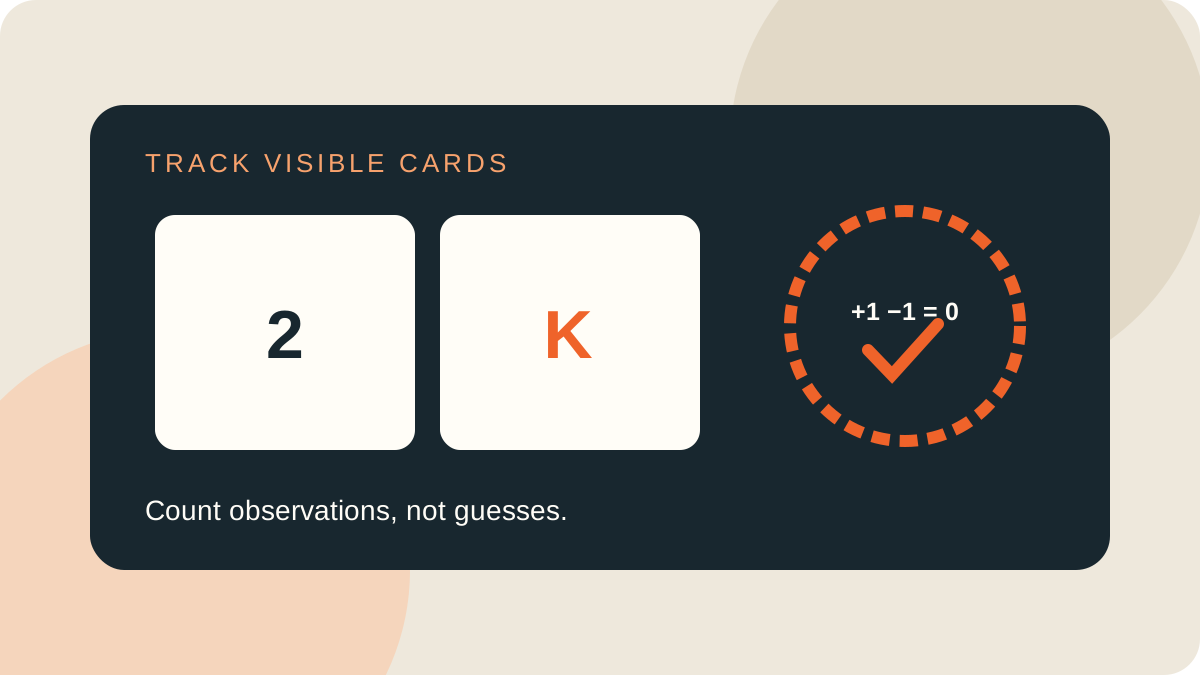
Hi-Lo assigns +1 to 2 through 6, 0 to 7 through 9 and −1 to tens, picture cards and aces. Begin at zero after a fresh shuffle. Update for visible cards according to the dealing sequence, including other exposed hands and the dealer’s cards when revealed. Do not count a hidden card you have not seen.
Convert carefully
The running count alone does not describe how concentrated the information is. Divide it by estimated decks remaining to obtain a true count. A running +6 with three decks remaining gives +2; with one deck remaining it gives +6. Index conventions can differ in rounding and deck estimation, so use the same convention as the system you are studying.
Keep departures rule-specific
A count-based departure compares a hand with an index under specified assumptions. The correct starting point is still a matching basic strategy. Surrender, dealer soft 17, deck count and other permissions can affect the decision. Do not apply a remembered number to a different rule set just because the hand total looks familiar.
Understand the limits
Frequent reshuffling, uncertain remaining cards, missed observations and different game mechanics can make an apparent count unsuitable for decisions. A positive count does not promise the next hand will win. The tutorial is an educational exercise using its displayed scenarios, not evidence of an advantage at a particular online table.
Try this next
- Learn basic strategy first.
- Practise tags without betting.
- Track exposed cards and the shuffle reset.
- Convert to true count before studying a matching index.
Common questions
Can I count every online game?
Do not assume so. You need the actual shuffle model, reliable observations and a suitable finite-shoe process. A live stream or a card animation is not enough.
Does a positive count mean I should always stand?
No. The hand, dealer upcard, exact count, rule set and index all matter. Counting does not replace the decision framework.
Keep learning
References and scope. Rules and strategy depend on the game. Worked examples on this page illustrate their stated assumptions; they are not forecasts or claims of casino testing.
Can you explain the difference between a running count and a true count?