The full guide
Put the lesson into practice
Learn the cards, follow a hand from bet to result, and practise the five decisions before playing for money.
The aim: beat the dealer, not the table
Your hand competes with the dealer’s hand. You win an ordinary comparison by finishing closer to 21 without going over. If you bust, your wager loses even if the dealer later busts. A tie is normally a push: the original stake comes back, with no winnings. Other players’ results do not decide yours.
Count the cards correctly
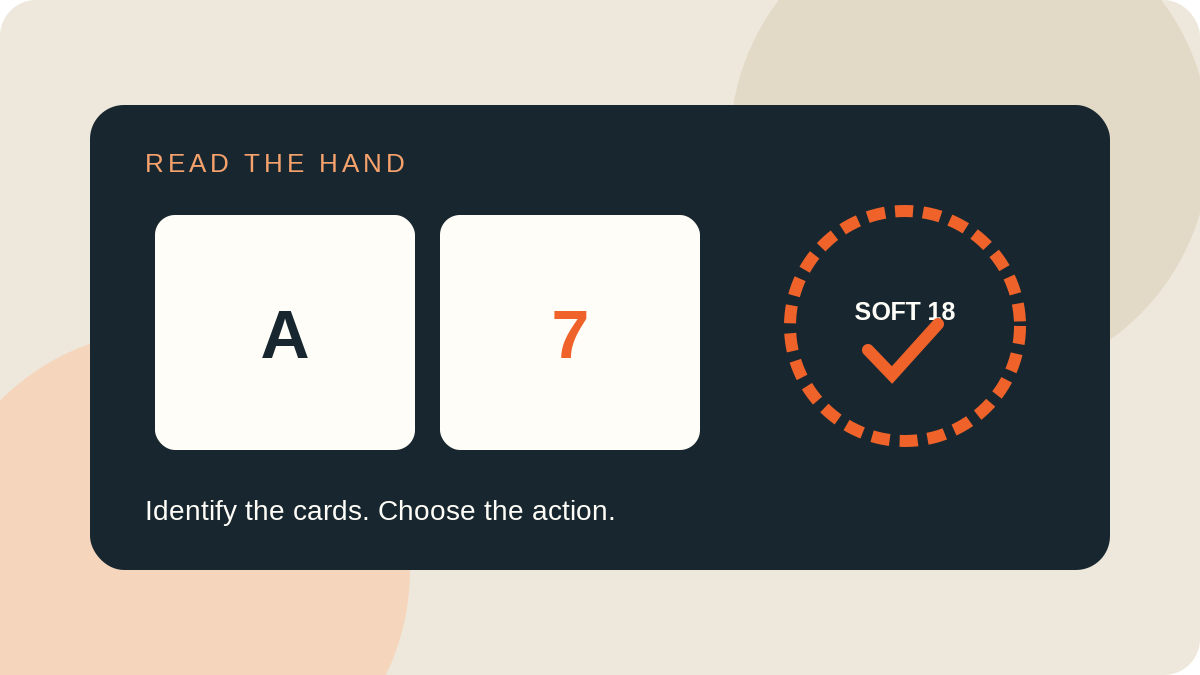
Number cards count at face value; tens and picture cards count as 10. An ace counts as 11 unless that would bust the hand, when it counts as 1. A soft hand has an ace still counted as 11. A natural blackjack is an ace plus a ten-value card in the first two cards; a three-card 21 is not a natural. An ace and ten after splitting are generally paid as an ordinary 21, subject to the rules.
Know the five decisions
Hit adds a card; stand keeps your total. Double adds a permitted extra wager and takes one final card. Split separates an eligible pair into two hands and needs another wager. Surrender, when offered at the relevant stage, ends the hand for half the original wager. The table can restrict doubling, splitting and surrender, so an unavailable action needs the correct fallback.
Watch the dealer finish
After player decisions, the dealer follows fixed drawing rules. Check whether the dealer hits or stands on soft 17, and whether the game uses a hole card and a blackjack check. You cannot assume that two games with the same name settle dealer blackjack the same way. Read the help screen before comparing strategy charts.
Learn in a useful order
Begin with card totals, then identify the dealer’s visible card, then look up the decision for the exact rules. Practise slowly and explain the move before pressing a button. A correct decision can lose; judge the decision against the rules and chart, rather than the next card. Our practice table scores decisions without money or a chip balance and displays its assumptions.
Try this next
- Read the payout and table rules.
- Deal a free practice hand.
- Identify hard, soft or pair before choosing.
- Check the result and explain your decision.
Common questions
Does 21 always mean blackjack?
No. A natural requires an ace and a ten-value card as the first two cards under the game’s rules. A drawn 21 is a different result.
Should I copy the other players?
No. Use your own hand, the dealer upcard and the rules. Another player may have a different decision or may be making a mistake.
Keep learning
References and scope. Rules and strategy depend on the game. Worked examples on this page illustrate their stated assumptions; they are not forecasts or claims of casino testing.
See how blackjack works
Start with the rules, then follow a demonstration. Pause before each decision and name the action you would take.
Players load only when you press Play. This connects to YouTube; its privacy policies apply. If playback is unavailable, use the YouTube or source link.
Learn the basics
Start with the rules, hand values and the choices available at the table.
Try this: Before playing: name the payout and dealer rule.
Follow a demonstration hand
See the rules and decisions in a blackjack demonstration. Judge the choice before seeing the result.
Try this: Write down the player cards and dealer upcard.
What would you check before using this information at a table?
Check your understanding
Three quick questions. Choose an answer to see why it fits. Your answers stay on this page.