The full guide
Put the lesson into practice
Learn how to read a hand, use a matching chart and review decisions without confusing a lucky result with a good play.
What basic strategy does
Basic strategy compares available actions under a specified ruleset. It chooses the action with the best expected outcome for the hand information used by the chart. “Best” can mean losing less on average in an unfavourable situation. It does not mean that the hand is likely to win, or that a session must finish ahead.
Identify the hand before looking it up
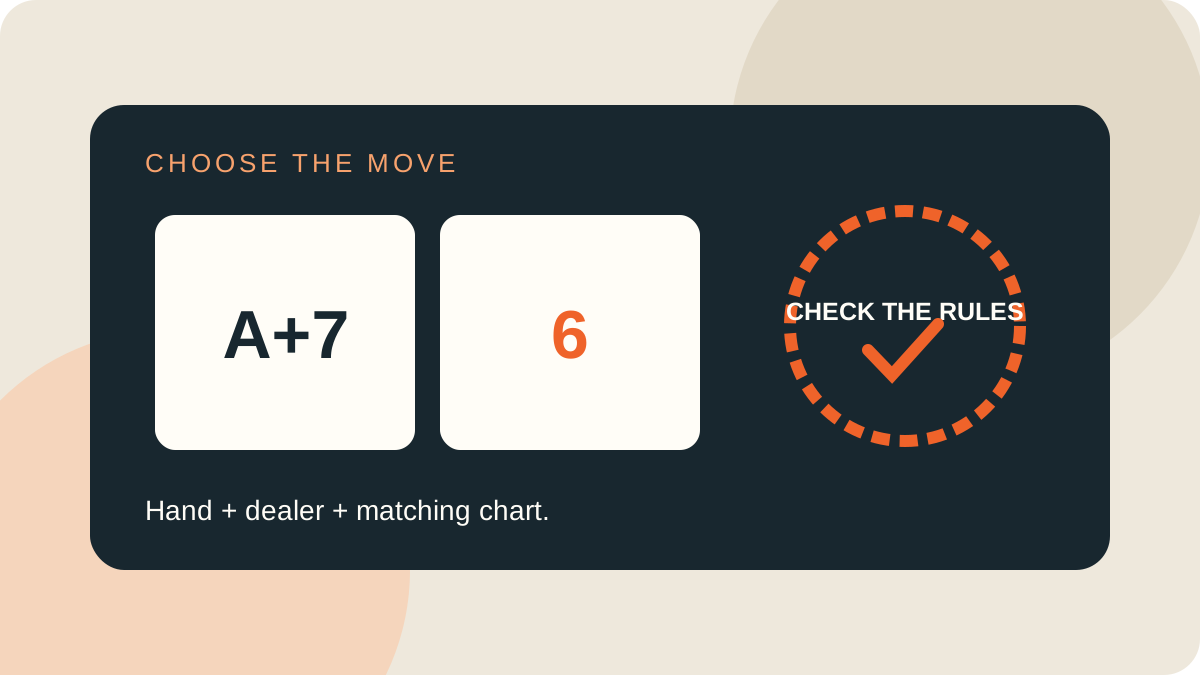
A pair, soft total and hard total can have different instructions even when the numeric total is the same. Two eights are not simply a generic hard 16 when splitting is available. A + 7 is soft 18; 10 + 8 is hard 18. Use the dealer’s visible card, not a guess about the hidden card.
Match every important rule
Our interactive chart assumes six decks, dealer peek, 3:2 blackjack and double after splitting. It offers S17/H17 and late-surrender settings. It is not a universal chart for European no-hole-card games, single-deck games or special variants. If your rules differ, find the correct reference before memorising its moves.
Read the fallback as well as the preferred move
A double instruction needs a fallback when the hand cannot double. Some soft hands stand instead of hitting when doubling is unavailable. Surrender is an initial-hand option only when the rules permit it. A multi-card hand, split hand or restricted action can change which instruction applies.
Review decisions, not streaks
After a practice hand, record the starting cards, dealer upcard, rules and chosen action. Compare with the reference before looking at whether it won. Do not change the next wager to “recover” a previous loss. Counting and tournament decisions require additional information and deserve separate study rather than improvised departures from a chart.
Try this next
- Confirm the rules.
- Choose pair, soft or hard.
- Find the dealer upcard.
- Read the action and unavailable-action fallback.
Common questions
Can the correct play still lose?
Yes. Strategy compares averages across possible future cards; a single result does not validate or disprove the choice.
Should I assume the dealer has a ten?
No. A chart evaluates possible outcomes. Treating an unseen card as certainly ten is not a substitute for strategy.
Keep learning
References and scope. Rules and strategy depend on the game. Worked examples on this page illustrate their stated assumptions; they are not forecasts or claims of casino testing.
Watch strategy in action
Follow the simplified strategy lesson and common questions, then compare each decision with the chart for your rules. The Excel lesson below is for a deeper look at the analysis.
Players load only when you press Play. This connects to YouTube; its privacy policies apply. If playback is unavailable, use the YouTube or source link.
Understand simple strategy
Follow a simplified strategy lesson, then compare decisions with a chart for your game.
Try this: Pause before an action and choose hit, stand, double or split.
Explore common questions
Use this blackjack FAQ to revisit questions that arise while learning the game.
Try this: Pick one answer and check which rules it assumes.
Advanced learning: strategy in Excel
Build strategy in Excel
An advanced lesson on analysing blackjack basic strategy with a spreadsheet.
Try this: Compare the alternatives under the same rules, rather than using one hand’s result.
What would you check before using this information at a table?
Check your understanding
Three quick questions. Choose an answer to see why it fits. Your answers stay on this page.