The full guide
What changes in this game?
Seeing the dealer’s full starting hand is valuable—but losing ordinary ties and receiving a smaller natural payout change the decisions.
Version covered: The Face Up 21 rules published by JackpotCash, compared with the Double Exposure family analysed by Wizard of Odds. Related versions can differ.
For comparison, ordinary blackjack uses standard 52-card decks, pays qualifying naturals according to the table, and normally pushes equal ordinary totals. Never assume every other rule stays the same.
| Feature | This reference version | Why it matters |
|---|---|---|
| Dealer information | Both starting cards are face up. | Use the dealer’s complete hard or soft hand, not a single upcard. |
| Ordinary ties | The dealer wins ordinary ties in this reference version. | Matching a standing dealer total can lose rather than return the stake. |
| Natural blackjack | An original player natural pays 1:1; a natural tie goes to the player. | Do not apply the ordinary 3:2 payout or assume every Double Exposure version has this tie rule. |
| Actions and dealer rule | The reference permits doubling hard 9–11, up to three split hands, and H17. | A chart must match those restrictions as well as the exposed cards. |
How the strategy differs
Start with the dealer’s full hand
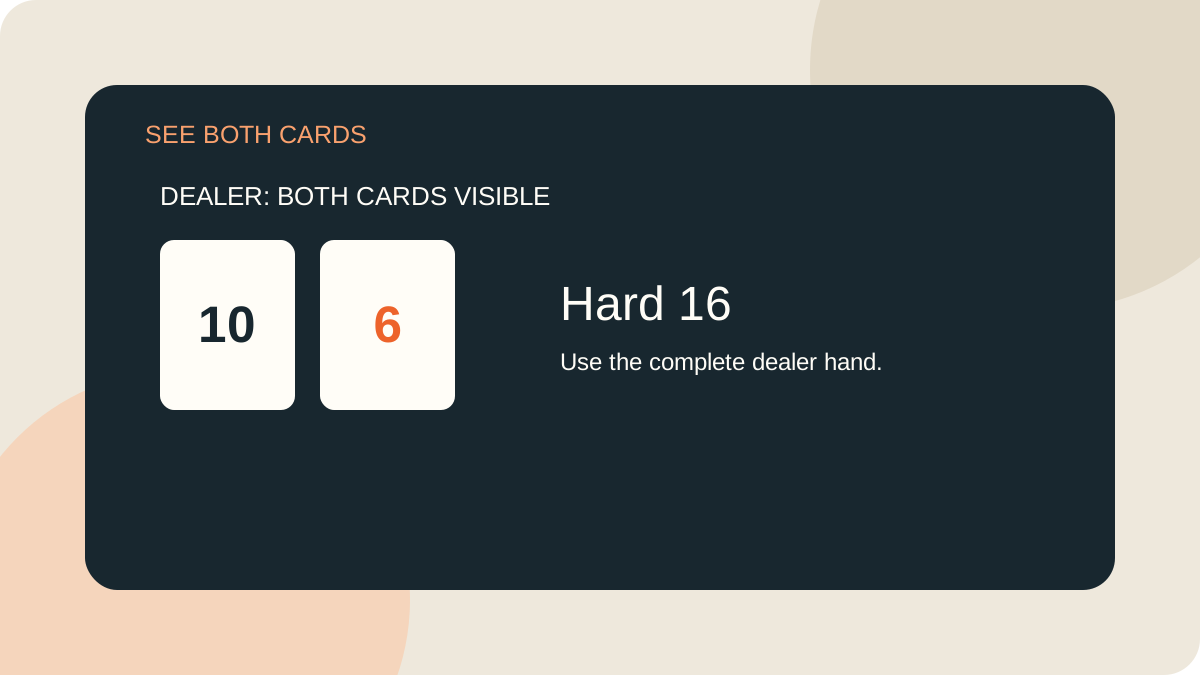
If you see 10 + 6, you know hard 16; if you see A + 5, you know soft 16. Those are different dealer states, even though both display 16. A conventional chart’s column labelled “6” does not represent either complete hand. Use a Face Up/Double Exposure chart that also matches whether the dealer hits soft 17.
Understand the price of the extra information
The extra information comes with compensating rules. Here, ordinary ties lose and naturals pay even money. An exposed dealer hand therefore does not make the game automatically better than standard blackjack. A fair comparison evaluates all payouts, permissions and card probabilities together.
A familiar stand can become a losing choice
When the dealer already has a terminal total and wins ties, standing on the same total can lock in a loss. That is a fundamentally different problem from facing a dealer upcard with an unknown second card. The worked example below shows the reasoning without pretending to be a complete strategy chart.
Check the particular implementation
Double Exposure references include versions with tied naturals that push, different doubling permissions and different split limits. Record the actual help-screen rules before selecting a chart. This guide explains the named reference; it does not confirm a current casino listing or supply a universal house-edge figure.
Before your first hand
- Identify the complete dealer total and whether it is soft.
- Check ordinary ties and tied naturals separately.
- Record the double and split restrictions.
- Use the matching Face Up strategy reference.
Common questions
Can I use the standard chart with the dealer total?
No. Its columns are upcards, not complete dealer hands, and it assumes ordinary ties push.
Do all Double Exposure games give the player a tied blackjack?
No. The reference analysis documents both player-win and push treatments. Check the exact rules.
Choose a matching strategy. Our interactive standard chart and practice trainer teach their own stated rules. They do not simulate this variation. Use the version-specific references below for variant decisions.
Compare another game
Rules and strategy references
Public references checked 29 October 2026. The examples use the stated rules; they do not establish current casino availability, a universal house edge or a guarantee of results.
Check your understanding
Three quick questions. Choose an answer to see why it fits. Your answers stay on this page.