The full guide
What changes in this game?
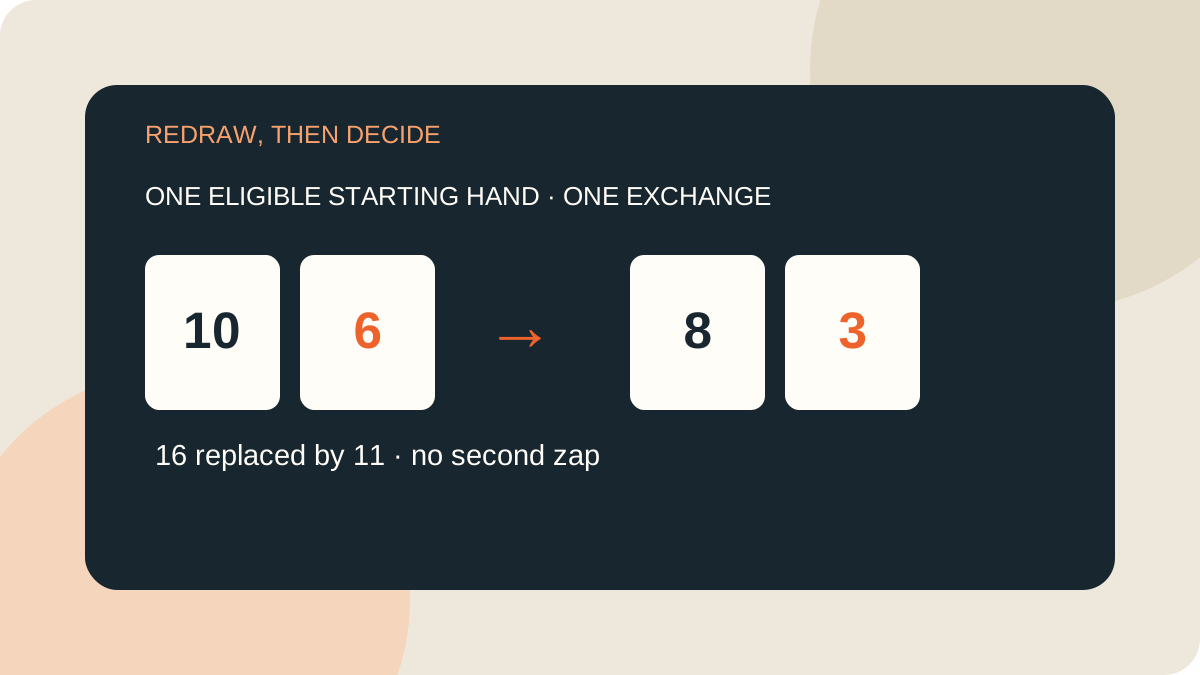
An eligible starting hand can be replaced with two new cards. Dealer-22 pushes and the treatment of a new blackjack change the value of that choice.
Version covered: Two rule profiles documented in the Wizard of Odds analysis: a 15–17 redraw profile and a 15–18 profile. They are rule examples, not a current casino-availability list.
For comparison, ordinary blackjack uses standard 52-card decks, pays qualifying naturals according to the table, and normally pushes equal ordinary totals. Never assume every other rule stays the same.
| Feature | This reference version | Why it matters |
|---|---|---|
| Redraw eligibility | Only eligible initial two-card totals may be zapped; the documented ranges differ. | A total of 18 is not universally eligible, and the exact hard/soft treatment must match the game. |
| Limits | No second zap after a zap; no zap after splitting in the analysed rules. | The option is one specific decision, not unlimited attempts to find a good hand. |
| Dealer 22 | A dealer bust total of 22 pushes against unresolved standing hands. | It does not undo a player bust or a previously resolved qualifying natural. |
| New ace-ten | One profile pays a post-zap natural 1:1 as an immediate winner; another treats it as ordinary 21. | The same replacement cards can have different settlement value. |
How the strategy differs
Make two separate decisions
First decide whether to keep or replace the eligible starting hand. Then play the retained or replacement hand under Zappit’s remaining rules. The redraw choice compares the expected value of both paths; seeing an awkward total alone does not prove a zap is better.
Record the timing of the dealer check
The documented 15–17 profile allows the zap before the dealer checks for blackjack. The documented 15–18 profile checks first. That timing changes the circumstances in which a redraw is available and the treatment of a resulting ace-ten. Keep each profile together rather than selecting its most favourable rules separately.
Dealer 22 affects normal decisions too
After the redraw phase, an ordinary blackjack chart still does not model the dealer-22 push rule. A dealer result that would normally pay surviving player hands instead returns the stake here. The matching Zappit reference has separate redraw and playing-strategy guidance for its stated deck and dealer assumptions.
Do not treat a redraw as a new wager
The zap exchanges the eligible cards under the game’s rules. It is not permission to add or cancel stakes, repeat the exchange, or erase an already completed loss. Check whether surrender, doubling and split actions are available after the exchange in the exact implementation.
Before your first hand
- Check the eligible initial totals.
- Find when the dealer checks for blackjack.
- Read how a post-zap ace-ten settles.
- Use separate zap and post-zap strategy references.
Common questions
Should I always zap 17 or 18?
No. Eligibility and the best decision depend on the profile, hand, dealer information and replacement-hand rules.
Does dealer 22 rescue a player who already busted?
No. The push rule concerns hands still standing, not an already lost player bust.
Choose a matching strategy. Our interactive standard chart and practice trainer teach their own stated rules. They do not simulate this variation. Use the version-specific references below for variant decisions.
Compare another game
Rules and strategy references
Public references checked 29 October 2026. The examples use the stated rules; they do not establish current casino availability, a universal house edge or a guarantee of results.
Check your understanding
Three quick questions. Choose an answer to see why it fits. Your answers stay on this page.