The full guide
What changes in this game?
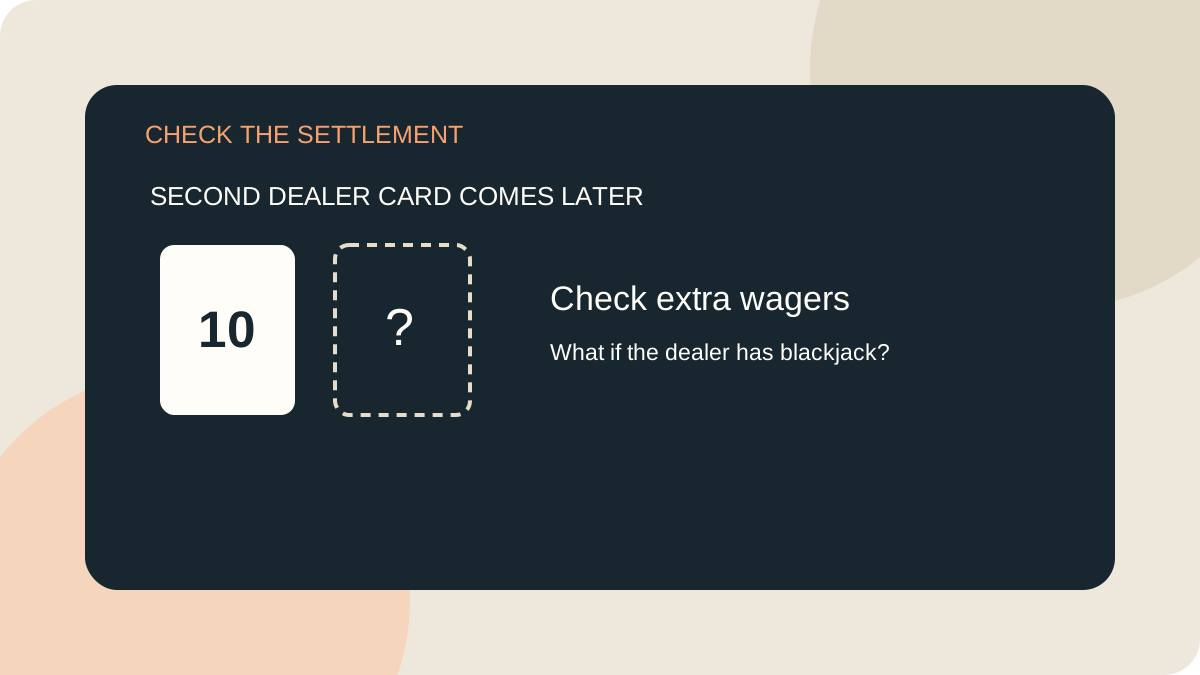
The important difference is not just when the dealer receives a second card. It is what happens to your extra split and double wagers if the dealer has blackjack.
Version covered: The all-bets-lost European rules described in Wizard of Odds’ RTG analysis. “European” does not guarantee one universal ruleset.
For comparison, ordinary blackjack uses standard 52-card decks, pays qualifying naturals according to the table, and normally pushes equal ordinary totals. Never assume every other rule stays the same.
| Feature | This reference version | Why it matters |
|---|---|---|
| Second dealer card | The dealer takes the second card after player decisions. | Additional wagers can be placed before dealer blackjack is resolved. |
| Dealer blackjack | In this all-bets-lost reference, doubles and splits are lost as well as the opening bet. | Distinguish this from original-bet-only protection. |
| Dealer and doubling | The reference uses S17 and doubles on hard 9–11, including after splitting. | Do not borrow a chart with different double permissions or H17. |
| Splits and surrender | Up to three hands; aces split once; no surrender in this reference. | Available actions and fallback decisions must match the actual table. |
How the strategy differs
Distinguish dealing order from settlement
No hole card describes a procedure. Original-bet-only and all-bets-lost describe financial treatment. A game can delay the second card yet protect some additional wagers, so the procedure alone does not tell you the whole risk. Read the dealer-blackjack clause explicitly.
Why doubles and splits need another look
Against a possible dealer blackjack, an extra wager may be exposed to a result that would have ended a peek game before that wager was placed. That changes the expected value of the double or split. It does not mean “never double” or “never split”: use an ENHC strategy matching the full rules.
Do not turn every difference into a blanket rule
The cited reference is S17, restricts doubling to hard 9–11 and has no surrender. Other products can differ. Deck count also matters. The source’s European strategy table is labelled for four or more decks; that does not validate the same moves for every game carrying the European name.
Compare the right costs
A dealer-blackjack settlement example isolates one outcome, not the game’s entire expected return. Do not add its worst-case loss to every hand or interpret it as a house-edge percentage. Combine a matching strategy with the actual payout and permissions before making a mathematical comparison.
Before your first hand
- Find when dealer blackjack is checked.
- Read exactly which wagers are lost.
- Record S17/H17, decks and double permissions.
- Use an ENHC chart for the matching settlement rule.
Common questions
Does no hole card always mean all bets are lost?
No. The dealing order and protection of additional wagers are separate rules.
Can the site’s interactive chart model this version?
No. It fixes dealer peek and DAS under its stated six-deck assumptions. It is a standard-game learning tool, not an ENHC lookup.
Choose a matching strategy. Our interactive standard chart and practice trainer teach their own stated rules. They do not simulate this variation. Use the version-specific references below for variant decisions.
Compare another game
Rules and strategy references
Public references checked 29 October 2026. The examples use the stated rules; they do not establish current casino availability, a universal house edge or a guarantee of results.
Check your understanding
Three quick questions. Choose an answer to see why it fits. Your answers stay on this page.